Search Hotels

Destination / Hotel Name

Check-in Date

Check-out Date


Recently on HotelsWhere.com

GC-200, Gran Canaria West Coast Road

Gran Canaria West Coast Road

The west coast of Gran Canaria (the one facing Tenerife) is very rocky and wild. You will not find towns here because there simply is not space for them. Most of the western coast is filled by high cliffs. It is possible to drive along the west coast – the road number is GC-200 and it is accessible either from the south (La Aldea de San Nicolas) or from the north (Agaete).

GC 200 and West Coast Pictures

The folowing are a few pictures I took when driving on Gran Canaria west coast road. The photos are ordered from La Aldea to Agaete.

Gran Canaria West Coast, GC 200

Gran Canaria west coast. The cliffs are more than 500 metres high.

Gran Canaria West Coast, GC 200

Gran Canaria west coast ends with Punta Sardina, the north-western cape of Gran Canaria. On the picture above, you can see the towns of Agaete and Sardina in the northern part of the west coast. Road GC-200 ends in Agaete. From Agaete the road continues as a bigger road, GC-2, to Las Palmas.

Gran Canaria West Coast, GC 200

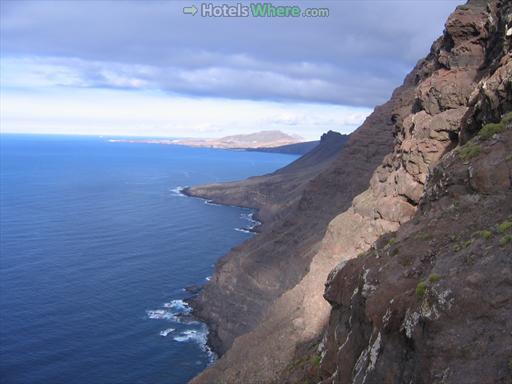
In a few places along road GC-200, you can look deep down to the ocean like this. You are several hundreds of metres above the sea level (I took this picture from Mirador del Balcon, which is 360 metres above the Atlantic Ocean).

Gran Canaria West Coast, GC 200

Mirador del Balcon is one of the best places on road GC-200 where you can stop and look around. Unlike other places on GC-200, there are parking places for several cars at Mirador del Balcon. The road gets very close to the coast here (in horizontal terms; in vertical terms it is the already mentioned 360 metres higher). You can see big part of Gran Canaria west coast from here.

Gran Canaria West Coast, GC 200

There is a balcony where the view gets even better. Mirador del Balcón literally means Balcony Viewpoint in Spanish. The mirador is close to the south-western end of GC-200 (near La Aldea de San Nicolas). It is in fact the first place after Los Caserones (the coastal village in La Aldea valley) where GC-200 gets to the coast again.

Gran Canaria West Coast, GC 200

Road GC 200 east of Mirador del Balcon.

Gran Canaria West Coast, GC 200

In many places, you can still see parts of La Aldea de San Nicolas and its characteristic polythene greenhouses.

Gran Canaria West Coast, GC 200

Here you can see Gran Canaria west coast directly from your driver’s seat. Be careful not to forget looking at the road in front of you. Other drivers may also get their attention divided between driving and sightseeing. A car appearing from behind a curve driving well into your half of the road is not uncommon here.

Gran Canaria West Coast, GC 200

Road GC 200 is constantly going to the very edge of the cliffs and back inlands again. You can’t count the curves.

Gran Canaria West Coast, GC 200

There is nothing but steep cliffs between the road and the coast.

Gran Canaria West Coast, GC 200

Another good place for looking around and taking pictures is on km 18 of GC-200. Parking capacities are much lower compared to Mirador del Balcon and it is probably not an official “mirador”, but almost all tourists driving the west coast road stop here. There is a small (5-8 metres high) rock between the road and the edge of the cliff – it is not hard to climb on it and the view is perfect. The picture above was taken from that rock. Be very careful not to fall down (it’s some 500 metres above sea level here).

Gran Canaria West Coast, GC 200

You can see a section of road GC 200 on the right.

Gran Canaria West Coast, GC 200

Amazingly, you meet quite a few trucks when driving on the west coast road. When you look at them and at the road, you wonder how they can fit in here.

Gran Canaria West Coast, GC 200

If you are a motorcycle fan, this is one of the panoramic rides to enjoy.

Gran Canaria West Coast, GC 200

There are not many villages on road GC-200 and on Gran Canaria west coast in general. One of the few settlements is El Risco, a typical white village in Barranco del Risco.

Gran Canaria West Coast, GC 200

Road GC-200 leaving Barranco del Risco.

Gran Canaria West Coast, GC 200

One of the few places on the west coast with more vegetation is Barranco de la Palma. There is some space for parking here too. See more information and more pictures here: Barranco de la Palma.

Gran Canaria West Coast, GC 200

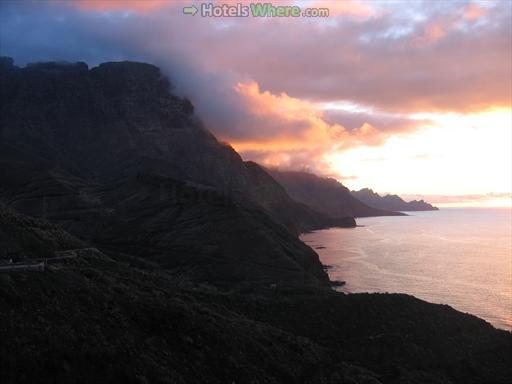
Evening on Gran Canaria west coast. After Barranco de La Palma, you are already getting close to the end of GC-200 in Agaete.

Gran Canaria West Coast, GC 200

From many places on GC-200 you can see Tenerife and Mount Teide above the Atlantic Ocean.

Gran Canaria West Coast, GC 200

The west coast road is one of the best places where to watch sunset in Gran Canaria. You can find more pictures of GC-200 and Agaete sunset here: Gran Canaria West Coast in the Evening.

Penang Aerial View

The following are aerial photos of Penang which I took on two flights. One was departing from Penang Airport bound to Kuala Lumpur – these photos are from relatively low altitude, with many details visible. The other flight was from London to KL, flying over Penang at high altitude, so you can see the whole island, but the quality is not that good.

Here you can see more information about where to stay in Penang. Here you can search hotels on Penang.

Penang Island from High Altitude

Penang Island from the air

Penang Island as a whole. Georgetown (the capital) is in the north-east (the top of the island on the photo).

Penang Island and Selatan Strait from the air

This is Penang (on the left) with the Selatan Strait, also known as Penang Strait, which separates the island from the Malay Peninsula (on the right).

Penang, Georgetown, and Butterworth aerial view

This photo is zoomed. Penang on the left, mainland on the right. In the north-eastern tip of the island you can see Georgetown. You may even recognize the KOMTAR skyscraper. Across the strait from Georgetown there is Butterworth. The darker strip at the bottom of the picture is the runway of Penang Airport. You can also recognize Jerejak Island, which is in the Selatan Strait close to Penang.

The Penang Bridge is not much visible on this photo (it will be on the lower altitude photos below). If you are familiar with Penang, you probably know where to expect the bridge (it is not in the narrowest point of the strait, which is off Georgetown in the north, but just slightly north of Jerejak Island).

Taking Off from Penang Airport

I was sitting on the left side. The aircraft took off to the south-west and immediately turned sharply to the east. All photos are looking to the east or north.

Takeoff at Penang Airport

Just after takeoff – houses in the south-eastern part of Penang between the airport and Selatan Strait.

Takeoff at Penang Airport

The land on the other side of the strait is the Malay Peninsula.

Pulau Penang and Pulau Rimau

The land on the left side is the south-eastern tip of Penang. The one on the right is Pulau Rimau, a small island off Penang.

Pulau Penang and Pulau Jerejak

This is the south-eastern part of Penang and behind it Jerejak Island. You may also recognize the Penang Bridge (a dark line across the strait just behind Jerejak).

Penang Airport aerial view

As the plane turned left sharply, I had a wonderful view of Penang Airport. Behind the airport there is Bayan Lepas and behind it in a distance you can see Georgetown.

Penang Airport aerial view

The runway (04/22) is 3.35 km long, which gives you some idea about the size of the island.

Georgetown and Penang east coast

The most detailed photo of the east coast I could take. In the bottom left corner there is still the (northeastern) end of the runway. The houses in front are all parts of Bayan Lepas. In the background there is Georgetown with the characteristic KOMTAR building. About halfway between the two cities you can see the start of Penang Bridge. If you have trouble finding the bridge, see the two small islets (dark spot on the very right) – the bridge goes just in front of (below) them.

Jerejak Island from the air

Jerejak Island (Pulau Jerejak), Penang Bridge, and Georgetown.

Penang Bridge aerial view

Penang Bridge, Georgetown (left) and Butterworth (right). Total length of the bridge is 13.5 km, but only 8.4 km is over the water.

Penang Bridge aerial view

The bridge could have been much shorter if built directly between Georgetown and Butterworth (the narrowest point of the strait is only 2-3 km), but I’m sure that are good reasons for its route (probably not wanting to take the traffic through the city centres, but I’m not an expert). The bridge was opened for traffic in 1985.

A second bridge, which is under construction (not visible on any of the photos), will connect the Malay Peninsula with the south-eastern end of Penang. It will be 24 km long, with 16.9 km over the water.

Koutoubia Minaret, Marrakech

Koutoubia Minaret in Marrakech

When non-Muslims refer to Koutoubia Mosque, the largest mosque in Marrakech, they often have only its tall minaret in mind. Entrance to the mosque is forbidden for non-Muslims like in most other mosques. The Koutoubia minaret is (maybe besides the main square Djemaa El Fna) the most popular and most significant landmark of Marrakech. You will find it on most postcards and tourist pictures of Marrakech.

Koutoubia Minaret from Parc Lalla Hasna

Koutoubia Minaret as seen from Parc Lalla Hasna.

Koutoubia Minaret as a Point of Orientation

Koutoubia minaret is 69 metres tall. It is visible from many places in the city and therefore can be a useful point of orientation when you get lost (especially in the medina). Koutoubia Mosque has perfect location virtually next to the main square, Djemaa El Fna. There is a broad street where (unlike in the medina) car and bus traffic is possible (Avenue Mohammed V) and many tourists arrive to Marrakech medina at this place. Be very careful when crossing this street though (watch the cars and not the minaret) – the traffic in Marrakech can seem rather unorganized to a foreigner.

More Pictures of Koutoubia Minaret

Koutoubia Minaret

Koutoubia Minaret in detail.

Koutoubia Minaret

Koutoubia Minaret behind trees. The picture was taken from the small park on the southern side of Koutoubia Mosque.

Koutoubia Minaret

Koutoubia Minaret from the south (Avenue Hommane Al Fatouaki).

Koutoubia Minaret

Koutoubia Minaret at night.

Sean O’Casey Bridge, Dublin

Sean O’Casey Bridge

Seán O’Casey Bridge is a pedestrian bridge in Dublin city centre. It crosses the River Liffey approximately 300 metres to the east from the Custom House and connects City Quay (south bank) with Custom House Quay (north bank). On the northern side near the bridge there are the Famine Memorial and the Jeanie Johnston Ship (and museum).

The Irish name of the bridge is Droichead Sheáin Uí Chathasaigh.

Sean O'Casey Bridge, Dublin

This is Sean O’Casey Bridge. The picture was taken from the south bank of the River Liffey, from the eastern side. You can see the Custom House in the background.

Views from Sean O’Casey Bridge

Sean O'Casey Bridge, Dublin

View from Sean O’Casey Bridge to the west (Custom House).

Sean O'Casey Bridge, Dublin

View from Sean O’Casey Bridge to the east (Jeanie Johnston Ship).

Gran Canaria West Coast in the Evening

Gran Canaria West Coast

The west coast of Gran Canaria between La Aldea de San Nicolas and Agaete is one of the most amazing sceneries you can see in the Canary Islands (and anywhere else).

Gran Canaria West Coast

The coast is very rocky here, with cliffs reaching hundreds of metres above the sea level, only occasionally interrupted by a dramatic barranco – a ravine, eroded by water. This part of Gran Canaria is not for beach lovers, but if you like nature (and actually consider rocks nature, which they are), you will enjoy it.

Gran Canaria West Coast, evening in Barranco de La Palma

Gran Canaria West Coast, evening in Barranco de La Palma.

Gran Canaria West Coast Sunset

The best time to come to the west coast of Gran Canaria is late afternoon and the evening before sunset. During about one hour around sunset, the cliffs, the sky, and the ocean change colours as the sun is disappearing behind the horizon. A few more sunset pictures follow.

Gran Canaria West Coast

Gran Canaria West Coast

Gran Canaria West Coast

Gran Canaria West Coast

Gran Canaria West Coast

Yes, the little triangle over there is Teide.

Evening and Sunset in Agaete, Gran Canaria

Agaete is the biggest town (or to be more precise, almost the only town) on Gran Canaria west coast. It is also the place where you can take a ferry from Gran Canaria to Tenerife, which is well visible from Agaete (namely from its port area, Puerto de las Nieves).

Gran Canaria West Coast

The clouds above the ocean in the distance hint that there may be an island – and it’s Tenerife. You can see Mount Teide rising from the clouds. On other days when there are not that many clouds, you can also clearly see Anaga Mountains (the north-east end of Tenerife).

Gran Canaria West Coast

The same view a moment later. When it gets darker, you can also see the lights of Tenerife towns – the most obvious is Santa Cruz, the capital of Tenerife. Unfortunately, in this case I couldn’t get those lights on the picture.

Gran Canaria West Coast from Agaete

Gran Canaria West Coast

Gran Canaria West Coast

Gran Canaria West Coast

This picture was actually taken long after the sun has disappeared in the waters of the Atlantic Ocean and barely a silhouette of the cliffs is recognizable. The black things at the bottom are concrete bricks, which serve to protect the port in Agaete/Puerto de las Nieves from waves (these bricks are very common in Canarian and Spanish coastal towns).

Getting to Gran Canaria West Coast

There are regular bus services operating along the west coast (though not as frequent as in the east and south). Nevertheless, if you really want to enjoy the views, come on your own (it is cheap to rent a car in Gran Canaria resorts).

The west coast road (GC-200) is literally carved into the cliffs and will challenge your driving skills. Be careful to plan your trip time-wise – what looks like 20 km on a map can easily become 2 hours, as you rarely exceed 40 km/h and your scenery-admiring and picture-taking stops can get quite long. There are a few designated places where you can stop the car and enjoy the view, and it is impossible in other places, as the road is really narrow.

One final note: If you come by a car and you need to return to the resorts in the south of Gran Canaria after it gets dark, it is much better to take the road to Las Palmas (GC-2) and then the east coast highway (GC-1), rather than trying to get there along the west coast and over the mountains (GC-200).

Irishtown Nature Park, Dublin

Irishtown Nature Park Location

Irishtown Nature Park is a small recreational area in the eastern part of Dublin, south of Dublin Port, along the coast of Dublin Bay, on the southern side of Poolbeg Peninsula. It is best accessible from Irishtown, a district between Ringsend and Sandymount.

Irishtown Nature Park, Dublin

This is the path from Irishtown leading into the Nature Park and to Poolbeg Peninsula. Dublin Bay is on the right. Poolbeg Power Station is in the background.

Irishtown Nature Park, Dublin

Irishtown Nature Park sign. Above the top of the hill you can see small tips of Poolbeg Power Station chimneys.

Irishtown Nature Park, Dublin

View from Irishtown Nature Park to the coast of Irishtown and Sandymount.

Irishtown Nature Park, Dublin

Dublin Bay is very shallow here. On low tide it is quite common to see people (and dogs) walking on the uncovered seabed.

Irishtown Nature Park, Dublin

There are many rocks along the coast, although many of them are actually man-made blocks of concrete.

Irishtown Nature Park, Dublin

One of the trails with beautiful views of Dublin Bay.

Irishtown Nature Park, Dublin

Overlooking the waterless part of Dublin Bay from Irishtown Nature Park to the east. You can see the Great South Wall and Poolbeg Lighthouse in the background on the left.

Irishtown Nature Park, Dublin

There are mostly rocks, sand, and grass, but you will find a couple of (small) trees too.

Irishtown Nature Park, Dublin

The trail climbing slightly up from the coast.

Irishtown Nature Park, Dublin

A beach in Irishtown Nature Park.

Irishtown Nature Park, Dublin

You can find many different kinds of seashells on the beaches around Dublin Bay.